The 1985 Project Part 72: Various Artists - Go Go Crankin': Paint the White House Black
The genre seemed poised to break nationally but remained confined to our nation's capital

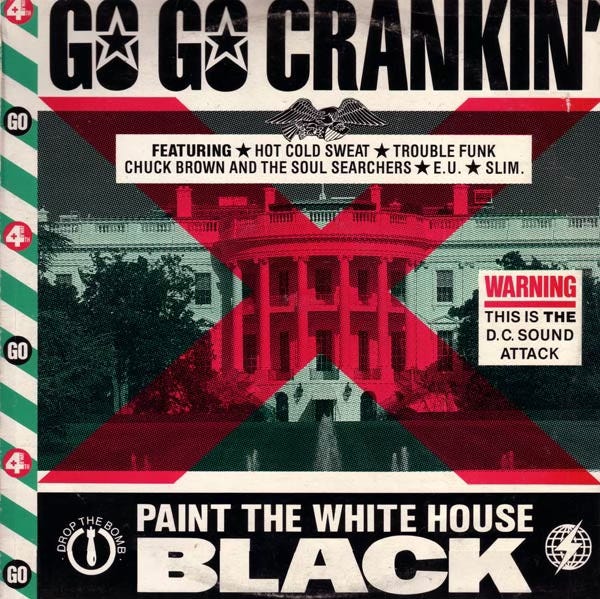
Go go music had been around for at least fifteen years before and it has apparently lasted in some form or another for forty years after the release of Go Go Crankin – Paint the White House Black in 1985. There was a feeling in the music world that maybe go go could capture the same audience as hip hop and somehow take off in a big way. That didn’t happen.
I had already been familiar with Trouble Funk when this record came out – I think we must have had at the record store a twelve inch single of “Drop the Bomb,” their most famous song which is included here. I distinctly remember seeing Black Flag somewhere around this time. While waiting for warm-up bands to perform, the sound system was blaring this album. I remember seeing Henry Rollins behind the mixing board feeling the good vibes of the go go rhythm in a way that seemed to make him oblivious to all his surroundings.
The go go experience was meant to be trance-like. According to all reports, live shows would go on for hours with the songs extended to great lengths and then blurring right into the next one without a break. The bands were rhythm heavy – in addition to the trap drum set, there were always multiple congas, and often rototoms and cowbells in the mix. The rest of the line-up would include guitars, bass, and synthesizers. Horns were present sometimes. Nothing was sequenced – go go music was organic funk.
Songs were more or less collections of words attached to notes without coalescing into melodies or even recognizable hooks. The band Slim, included here, incorporated rap, but most of the go go bands of the time would chant, sing, or simply intone lyrics. The music was about rhythm, and everything was meant to push people into dance floor moves. (Several of the songs here – “Let’s Get Small” by Trouble Funk and “Happy Feet” by Mass Extension especially – are in the grand tradition of describing new dances.)
Chuck Brown and the Soul Searchers were the grand viziers of the form – they had a hit single in 1978 with “Bustin’ Loose” which I guess was taken as a novelty version of disco at the time. Their cut here “We Need Some Money (Bout Money)” shows they still had all their energy and excitement in the tank. E.U. gets two cuts on the album. A few years later, they would break through with a mainstream hit, “Da Butt.” In 1985, they had a woman singer alternating with Sugar Bear, the lead voice and bass player. Their song “Somebody’s Ringing That Doorbell (Express Yourself)” includes a wide variety of spoken impressions of the likes of Howard Cosell, Mohammed Ali, Hervé Villechaize, Bootsy Collins, and Walter Cronkite.
The stars of the album, though, are Trouble Funk. “Drop the Bomb” is such a glorious burst of syncopation and synthesized squiggles. Big Tony Fisher was the lead vocalist – he had a deep resonant tone that points in the direction of Chuck D of Public Enemy combined with influences from Parliament-Funkadelic. In this song, he lays out plans for national domination, listing all the cities in which Trouble Funk intended to drop the go go bomb. “Let’s Get Small” and “Say What” aren’t quite as memorable but they are every bit as full of energetic rhythms.
Ultimately, the limitations of go go – lack of catchy hooks, emphasis on partying rather than emotional or political ideas in the lyrics – combined with the endurance tests that I presume some people found with bands that never stopped onstage - kept the music from spreading outside the Washington, D.C. area. I’m glad it still exists in some form. But for me, it was the few attempts at national acceptance in the 80s, highlighted by this compilation, that I will always love. This album gets an 8.5 out of 10 points.